Organizational Priorities: additional values to focus on and pay attention to now

Organizational Priorities are the third component of Core Culture. They are located one layer outside of Purpose and Philosophy. (See the image below.)
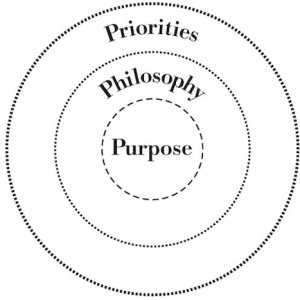
Core Culture = Purpose + Philosophy + Priorities
Priorities are an added layer of core values to guide the organization. To clarify:
- Purpose is the guiding principle expressing why the organization exists.
- Philosophy is the distinctive and relatively enduring set of core values guiding how employees do their work.
- As a unit, Purpose and Philosophy together are the distinctive identity of the organization. They are the core principles and values that are relatively stable over time. They serve as the basis for the business and how employees do their work.
But the Purpose and the Philosophy may not address all of the current requirements to be a thriving organization. This is where the third P of Core Culture–Priorities–comes into play. To clarify, Priorities are additional values the organization must focus on and pay attention to now.
The current business environment and the anticipated future influence these values. Therefore, Priorities ensure the organization has the focus that will drive success.
Organizations have their distinctive identity. But identity alone does not constitute Core Culture. For an organization to thrive, it must have the capability to shift and adapt. Priorities enable an organization to thrive in a changing world while sustaining its distinctive identity.
Organizational Priorities integrate change into the Core Culture
Priorities are not typically as stable as the Purpose or the Philosophy. To clarify, Priorities can change as the environment—within or outside the organization–changes.
 Priorities allow the organization to have an adaptive, resilient culture. To survive, organizations must change. The need and degree for change may vary depending on the industry and the times.
But, most industries today don’t have the luxury to relax. They must seek to predict the future and even invent it. It is the Priorities that keep an organization agile and alert. To sum up, Priorities provide the momentum to change behaviors that will enable the organization to thrive–while sustaining its distinction–its identity (the Purpose and Philosophy).
Organizational Priority example: Health & Safety
For example, think about the issues in the news today. Now, most organizations must adapt to a new disease that has created a global health and economic crisis. Companies have changed their Priorities to have this new focus.
 For most companies, a new Priority is a heightened focus on health and safety. Consequently, for example, there is a need for implementing virtual work practices for employees. Also, for those coming into the office, health and safety has become a prime focus.
New Practices are implemented to support employee and customer health and safety.
Organizational Priority example: Emerge Smarter
IBM has adopted the Priority–emerge smarter. To clarify, they describe it this way:
It’s time to rethink how business works. Take action in six key areas to emerge smarter, more resilient and more agile for years to come.
A Priority to emerge smarter implies a more flexible, resilient, and agile organization.
 This Priority applies to internal Practices like how employees work–in a safe environment and effectively using virtual agents in doing one’s work.
Likewise, it applies to external Practices in its products and services. IBM seeks to “engage customers anywhere with Watson,” focus on “IT resiliency and business continuity,” “accelerate agility and efficiency with cloud,” “address new cybersecurity risks,” and “reduce operational cost and ensure supply chain resiliency.”
These are examples of a new Priority that leaders integrate in the Core Culture to meet the requirements of current conditions. And when an organization adopts new Priorities, everyone must align Practices with the Priorities.
As conditions change, you can replace Priorities with a different focus.
An organization has stability–through its Purpose and Philosophy. In contrast, it supports needed change through its Priorities.
That is to say, Priorities direct the organization on how to behave in order to achieve its goals and build an engaged workforce.
Two types of organizational Priorities
There are two types of organizational Priorities. To clarify, there are strategic Priorities and universal Priorities.
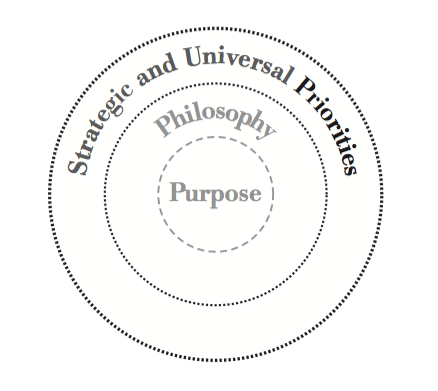
1. Strategic Priorities
Strategic Priorities are a part of the Core Culture. They are the additional values that align with the organization’s Vision and Goals. Therefore, incorporating these strategic Priorities into the core of the culture ensures that the culture will support the organization’s strategy.
Strategic Priorities are values specifically related to an external, customer, and market focus. But they can also impact internal Practices. For example, the Priority of Health and Safety would impact internal Practices with employees and external Practices with customers.
You can uncover these Priorities by understanding what the organization needs to focus on in order to achieve its business goals. If the economy is undergoing a recession, then cost control might be a strategic Priority. Or if competition is moving quickly to take over future markets, then speed might be a strategic Priority. Therefore, strategic Priorities change over time as the organization’s strategy changes.
There is no generic list of strategic Priorities. These Priorities are specific to the organization and its goals. Although organizations in a similar industry may have similar strategic Priorities. For example, in industries like banking, cyber security has become a strategic Priority.
Additionally, many companies in a variety of industries have adopted the value of sustainability as a strategic Priority.
Similarly, companies are also seeing digitization as a strategic Priority. Some companies like L’Oreal experienced a ten year’s growth in e-commerce in less than ten weeks due to the pandemic.
Also, a number of U.S. companies have identified sourcing outside of China as a strategic Priority. With the presence of trade tariffs and supply issues, companies are re-evaluating their sourcing practices.
2. Universal Priorities
Universal Priorities are also part of the Core Culture. They are the additional Priorities that have a targeted internal, employee focus. To clarify, these universal Priorities are the areas the company needs to focus on to have a more engaged workforce.
The values that support employee engagement are universal to all organizations. To explain, universal Priorities nurture an enriching and motivating workplace–whether it is on site or virtual. This type of workplace stimulates exceptional efforts and heightened loyalty.
To clarify, in an ideal world, these values would not be differentiators. But organizations do not uniformly live these values. Therefore, the presence of these values enhances the competitiveness of the organization. However, the absence of these values deters an organization from achieving its potential.
The universal Priorities consist of the following values: fit, trust, caring, communication, achievement, and ownership.
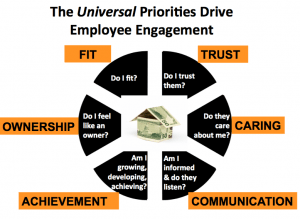
For example, does your organization hire for fit? That is, do they screen job candidates for fit with the culture and fit with the job? Do you provide a workplace that is trusting and caring? Is communication open and effective? Do employees have opportunities for growth and achievement? Do you support freedom, responsibility, and a sense of ownership?
Through an employee engagement survey, a company can identify the values that are the company’s key drivers of engagement to focus on. For example, if the survey indicates low levels of trust, then trust would be one of the company’s universal Priorities.
Go to this link to learn more about universal Priorities.