What is the Philosophy of your organization?

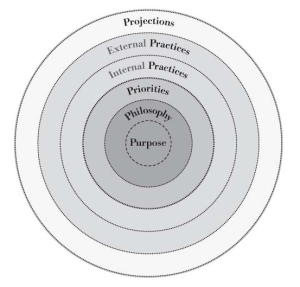
The Five Ps
To sum up, where the Purpose states “why” the organization exists, the organizational Philosophy directs “how” employees distinctively do their work. And, above all, “how” you do work matters. In successful organizations, employees consistently use this core attribute to guide their decisions and daily actions.
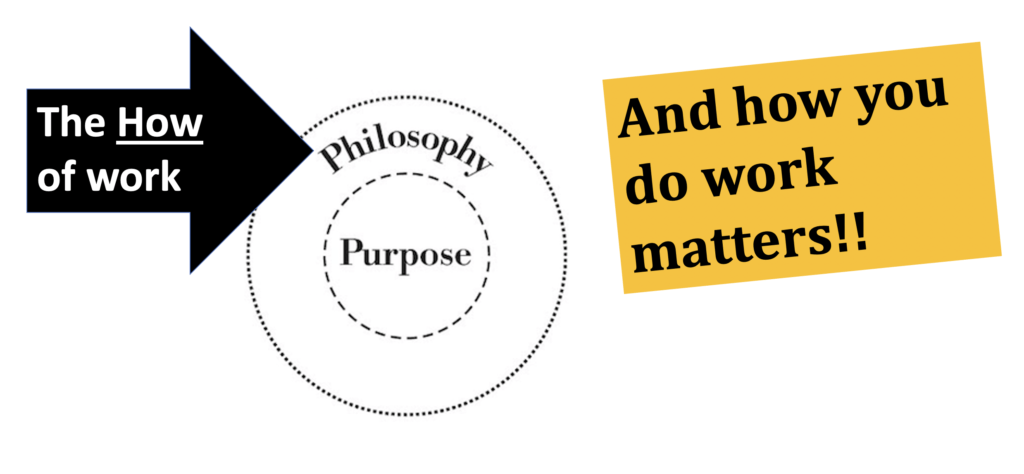
The organization’s Philosophy is its distinctive and relatively enduring principles and values
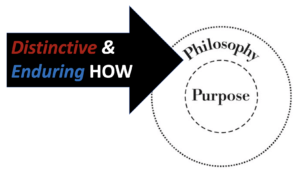 The Philosophy may be one principle or core value or a small set of principles and core values. Of course, many values may feel important, but seek only those that are fundamental, distinguishing, and relatively enduring to the organization.
They are the beliefs that have been essential and core to the character of the organization over the years.
Employees believe that it distinguishes their organization from others, particularly those which fulfill a similar Purpose.
The organization’s Philosophy is the enduring core beliefs that should rarely change. That is, unless an organization cannot stay in business being who it has been in the past. Therefore, it is what employees believe in today, what was most important in the past, and what will continue to be important in the future.
Even with the need for change, typically it is the Priorities that integrate change into the culture. The Philosophy is the strength of the organization that usually needs to be emphasized rather than replaced.
Philosophy is a reflection of the founder
The Philosophy of an organization is like the personality or character of the organization. To clarify, this character is typically derived from the organization’s founder. That is to say, organizations reflect their founder’s values and beliefs. In addition, the principles and ideals that drove the organization’s creation can determine this key attribute.
As an example, consider Steve Jobs, founder of Apple. Many of his personal traits and values became the distinguishing Philosophy of the company. Some examples include the importance of design, his quest for perfection, and his desire for simplicity. Many of his beliefs were derived from his childhood and young adult experiences including his Zen training.
His view on technology was different from other companies. As Jobs said,
“It is in Apple’s DNA that technology alone is not enough—it’s technology married with liberal arts, married with the humanities, that yields us the results that make our heart sing.”
Jobs believed that when computer scientists work together with artists and designers, then the best ideas emerge. This distinctive perspective was central to the Philosophy of Job’s companies.
In an interview with now CEO Tim Cook in January 2021, Cook was asked what he was proudest of over the last decade since Job’s death. Cook’s response was: “I’m proudest that we have kept his DNA as the core of the company.”
It is the soul of the organization
To sum up, where the Purpose is the heart of the organization, the Philosophy is its soul.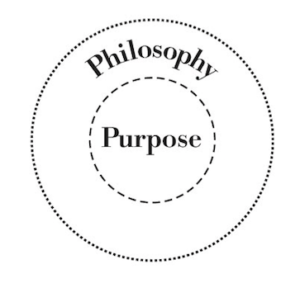
The five criteria to decide Philosophy
- Firstly, is it a prime principle or value?
- Secondly, does it guide “how” we do our work?
- Further, is it a source of our distinction?
- Moreover, has it been an enduring value over time? Is it derived from our founder/leader or the ideals that drove the organization’s creation?
- And, above all, if changed, would that alter the character of the organization?